Key Points:
Google reviews are worth a ton of money to local businesses.
Good reviews increase brand recognition, improve SEO, and convince leads to become renters – so it’s no surprise that some businesses have been gaming the system to get more reviews!
In April 2026, Google updated their review policy to ban several review-gathering tactics, including some storage industry common practices!

Google is the primary place where digital business is done. Google’s algorithm tries to find the best businesses (the ones customers like best) and puts them in front of more people. Businesses try to convince the algorithm that they are the best choice!
Business owners and SEO specialists discover ways to encourage the algorithm to choose them, and Google tries to keep the playing field level (while selling ads).
Reviews are incredibly important, so some business owners found ways to get more, better reviews beyond simply providing better service. This involved paying for reviews, offering discounts for reviews, and asking non-tenants for reviews, among other things. Google banned these practices a while ago, but the April 2026 update added new categories.
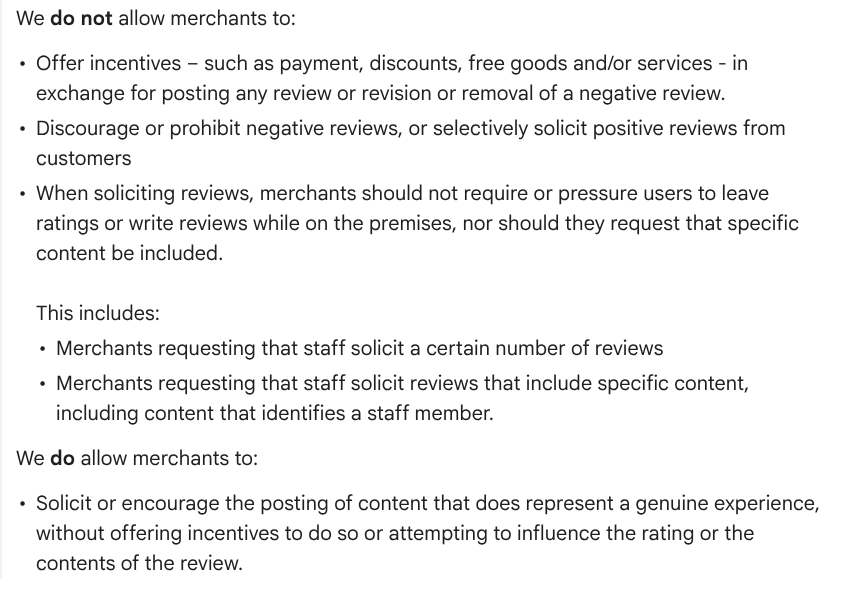
The April 2026 review policy change bans:
You can find Google’s actual policy here. We’ve also included a screenshot of the relevant portions:
Reviews work better if they mention specific amenities, specific services, or specific moments that impacted the customer. Compare these two reviews:
Vs.
The longer one is clearly going to convince more people to rent with you – but tenants are much more likely to leave the shorter! This led operators to encourage, or in some cases pressure, the reviewer to say specific things. Google is trying to stop that.
Owners have also set review quotas for staff, especially in positions like a self storage manager. This can lead to the employee feeling pressured and, in turn, pressuring the customer to leave a specific review!
Both of these situations contribute to inaccurate reviews, which makes Google’s job harder, so they are trying to stamp it out.

Google has a range of options it can use on profiles that are suspected of breaking the rules. In order of likelihood, Google could:
By far the most likely consequence would be that your profile loses reviews. If the algorithm determines you have systematic problems, the implications will get bigger.
If you’re an independent operator who isn’t trying to break the system, you probably don’t have to worry about getting banned. Instead, the most likely issue you’ll face is disappearing reviews.
Most monitoring is done with AI tools, and Google doesn’t want to punish anyone unfairly, so they simply remove the potentially faulty review. Because this is a light punishment, Google uses it pretty freely. This can lead to reviews being removed unfairly – but often, business owners don’t even notice.
Companies like BrightLocal offer review services that can help you track and retrieve reviews that have been removed unfairly. Without software like this, it’s nearly impossible to get lost reviews back because the review exists only on the reviewer's profile.
If you don’t know the exact Google account that left the review and when, Google can’t restore it, even IF you convince them it wasn’t fake.
In our Guide on Getting More Reviews, the experts recommend incentivizing your managers with cash rewards for a certain number of reviews. The new guidelines don’t expressly forbid that, but they do forbid giving employees a quota! Does that include bonuses? It’s unclear.
For the moment, here’s our best advice:
A fair review system is good for everyone. It helps customers figure out which businesses are best. It helps businesses focus on providing good service! But it’s hard to keep the system fair, especially when so much of the process is online.
For most small, independent operators, these updates won’t change your review process! You are still allowed and encouraged to ask your customers for reviews. The updated guidelines try to keep operators from tampering with reviews or gaining reviews unfairly.
Encourage your customers to leave honest feedback, and make sure you’re providing 5-star service. Make it as easy as possible for them to leave a review by providing a link or QR code. If you reward managers for getting reviews, the new rules don’t explicitly forbid it – Google only says it does not allow quotas. This is still a gray area, though.
Local search expert Darren Shaw suggests rewarding the whole company (or in our industry, everyone at a facility) when you hit a review target. For many facilities, that’s the same thing as rewarding a specific manager, and does not violate the guidelines.
Whatever you do, don’t let these new guidelines prevent you from starting a review program! Ask your tenants and do a good job for them – just don’t try to game the process! A fair review system will help independent owners stand out on Google like they do in the real world!
At StoragePug, we build self storage websites that make it easy for new customers to find you and easy for them to rent from you.