AI shopping searches grew 4,700% between 2024 and 2025.
Over half the population began using AI tools in just three years. That’s faster adoption than the Internet and personal computers.
AI-driven traffic to e-commerce sites increased 302% last year.
Clearly, consumers are flocking to AI, but are they using it to search for storage? And if so, what does that mean for you?
Have you ever searched for storage with AI?
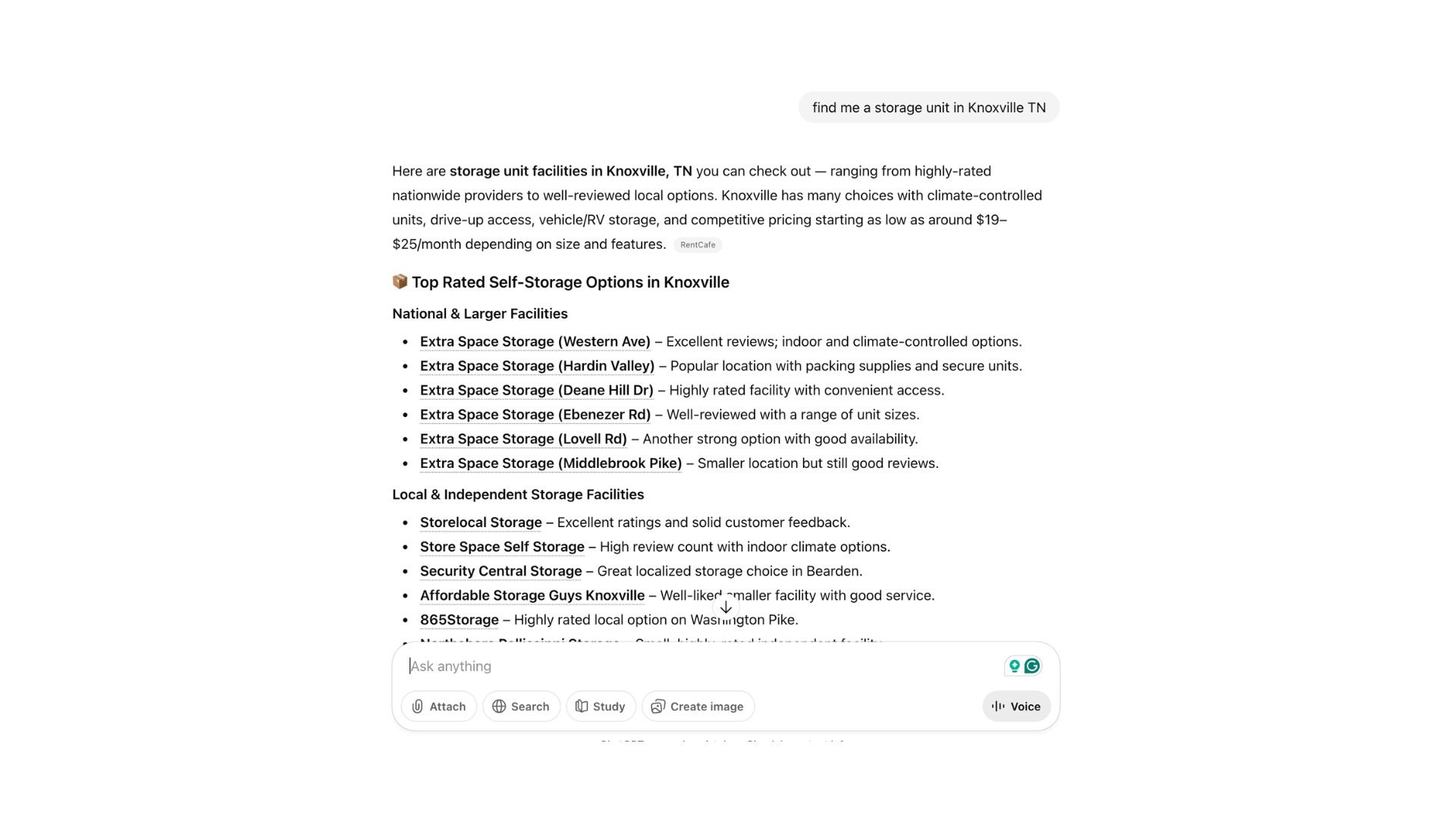
Here’s a search Tommy did a few weeks ago:
Then here’s a search I did a few minutes before writing:
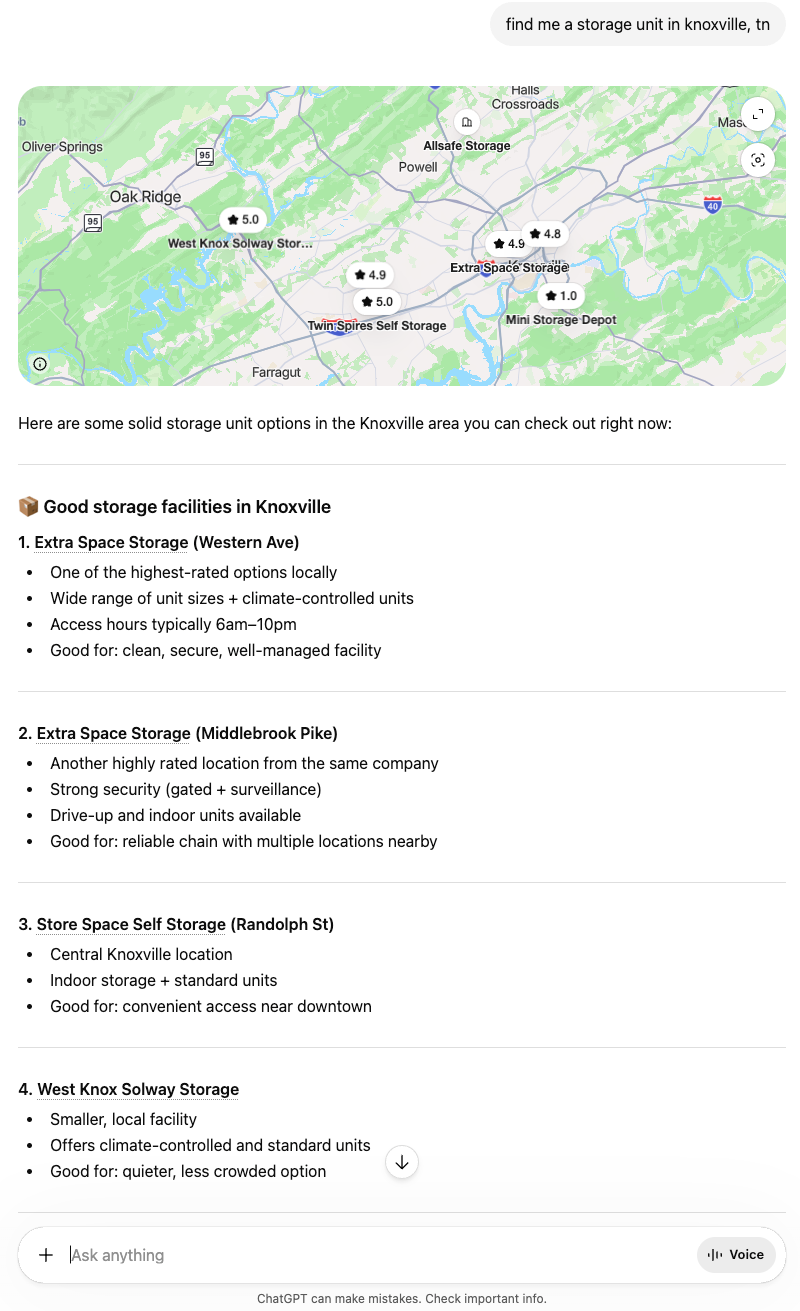
Same program, same request, same location – but wildly different responses. Some of the facilities are the same, some are different, and the way ChatGPT provides the answer has very different contexts.
The first answer provides a comprehensive list, weighted heavily towards Extra Space. The second still volunteers Extra Space as a priority choice, but then gives reasoning and a map. The actual facilities chosen are different, too.
When your customers search for storage, they could get either one of these results or something completely different. AIs adjust for individual user preference, chat history, and even use intentional randomness – making it very hard to know exactly how your business is going to show up.
But we DO know that AI search is growing. “Traffic to US retail sites from generative AI sources grew 4,700% year over year” per Ringly.
Self storage isn’t seeing an AI boom (yet). StoragePug is tracking total traffic and rentals through AI sources, and in 2025, only 0.079% of online rentals came from AI.
HOWEVER – as AI grows elsewhere, your customers are learning to use it. Eventually, like with online rentals, they’ll expect to use AI to shop for storage too.
This guide will teach you how people use AI to search, how AI chooses what to show, and how you can show up more often in AI search! Then we end with a breakdown of all the different things you can do to show up higher, ranked by effort vs impact.
If you want to learn more, check out the entire AI workshop here:
We understand how Google sends us customers.
Someone decides they need a storage unit, they go to Google, and they search for one (or they search for your brand if your referral game is working). They see a list of websites on the map pack, then more below.
If your website stands out, they click it, and your website converts them into a renter.
AI isn’t that simple.
Even people who use AI to shop mostly use it to research brands and products, instead of as a primary means of making a purchase. They ask Claude or ChatGPT what they should do about a problem, then go to Google to make the actual choice.
We don’t know if that will always be the case, or if this behavior is just temporary while people adjust to the new technology. Right now, shoppers are more comfortable with Google (or calling your facility) when they’re actually renting.
AI is adding another step, rather than replacing traditional search. People will ask AI what to do with inherited furniture, or where they can safely park their RV long-term, or for advice on cleaning out their garage.
Or, they might ask for the best storage in [your town]. Storage renters don’t often know much about the industry, so they outsource the research to an AI. Your lead doesn’t know how important smart units are vs. climate control vs. security cameras – Claude will give them a breakdown they can understand.
After they get that recommendation, they’ll want to check you out themselves. The shopper will check out your photos and videos, your reviews, and the impression of your business to make sure they’ll feel comfortable renting with you.
To most customers, storage facilities are all the same. Your job as a business owner is to give your business a way to stand out. One way to do that is to show up in AI recommendations!
Building the Future: Self Storage AI
If you’re looking for technical ways to optimize your website -> go here
Everything we know about AI search is currently in flux. It’s possible that Anthropic and OpenAI release new models tomorrow that understand search in completely different ways!But I don’t think that’s likely, for several reasons. The internet is inherently anonymous. Anyone can make a new website. Google and AI tools both need to verify that your business is real and useful. Your customers do that, too! Everyone relies on social proof to judge your website, and even a cutting-edge AI model can’t get around that.
To show up higher in AI search, you’ve got to control and improve your social signals.
Social Signals to Focus On:
Of course, there are tons of technical specifications that can help or hurt your AI performance, but if you’ve got a professional self storage website, you shouldn’t have to worry about them.
Instead, as a business owner, your energy should be going to these social signals.
Reviews are the single most important signal. We’ve seen businesses with terrible websites rank highly for high-value searches because their customers love them.
Check out our guide to getting reviews for self storage if you’re not already doing this. Quantity, quality, and recency all matter for reviews, which is great for small businesses. Even if you’re battling an Extra Space with 700 reviews, you can win if your reviews are better, more detailed, or more recent.
Google does not want you to require your managers to meet a quota of reviews! Read more
about Google's updated guidelines here.
A strong Google Business Profile does more than just host reviews. AI scrapes your GBP for hours, services, address, etc. Everything it knows about the physical business comes from the GBP!
Make sure your GBP has everything filled out, all the information is accurate, and that there are no competing signals. If you have a listing on a reference site with your old phone number, AI will find that. It might serve the wrong phone number, or it might decide not to show your business at all.
Mentions are similar to backlinks, except you don’t need the actual link. “Mentions” are anywhere your business name comes up on the internet or in AI training data. That can be a local Facebook group talking about your service, or a Grand Opening announcement on the local newspaper’s website.
Every time someone mentions your business online, that’s proof that you exist (remember, anyone can make a website – AI needs to know who’s real). Then the context of those mentions tells the AI how people feel about your business. Some of this is out of your control. You can’t make everyone happy! But if you create a consistent 5-star experience, the good mentions will outweigh the bad.
There are a few ways you can put your finger on the scale, though!
Sponsorships – Sponsoring local groups is a great way to give back to the community and get your name out there. Any group you sponsor should have a list of its sponsors somewhere on its website. Most will even link back to your website, which helps your Google rank as well as AI. If you sponsor local school sports teams, that gets you a mention on an authoritative .edu website.
Business Partnerships – Look for friendly local businesses that you can partner with. Start with real estate agents, movers, outdoor equipment sellers, etc., but you can also loop in restaurants, coffee shops, and anyone else around. Tell them about your referral program and make sure they know there aren’t any limits. Link to them from your site (and mention it) and see if they’ll link back.
Local Forums – This might be Facebook, Reddit, or some other place, but you can get mentioned. Just be careful! It’s very easy for businesses to come across as greedy, self-interested, or dishonest. Look for people you can genuinely help, then genuinely help them. Offer a special discounted rate, or suggest yourself alongside other competitors you trust. Don’t try to hide the fact that you would make money, either. Be honest, be helpful, and solve problems!
Ranking well in Google does not mean you’ll necessarily do well in AI searches – but it’s really hard to do well in AI searches if your website doesn’t have the SEO basics down. ChatGPT queries Bing, Gemini uses Google, Perplexity pulls from both, and Claude uses Brave Search.
To put it simply, AI pulls from a wide variety of results. Most humans click on the top result, or at least something on the first page, but AI doesn't have our limited attention span. If your website is in the top 40, you’re “eligible” to be cited.
This is a huge boost for smaller businesses! Beating the REITs to the #1 spot is incredibly difficult, but AI doesn’t care about #1. It only cares if you’re a good option for the specific person searching.
Learn More About Self Storage AI Here
Summary: Make sure your website works well with AI, but remember, every single AI search result is unique. Don’t expect SEO-style rankings. AI platforms are continuing to experiment with their results, and searchers are continuing to evolve how they use them.
If you have a professional website, you don’t need to worry about the technical factors of ranking for AI. If you’re doing OK in regular SEO, technical factors will be less important than reviews, your GBP, and business outreach.
That being said, technical factors can sometimes hold your website back. The biggest single issue that operators run into is inconsistency. If you bought your facility eight years ago and the previous owner had a seldom-used profile on YellowPages, no customer has ever seen that wrong phone number – but the bots will.
The best ways to improve your AI positioning, ranked by effort and benefit:
Tech-forward operators can look into some of the technical aspects listed above, but for most owners, it’s not worth the effort. If you have a professional web developer, the technical stuff is (most likely) already handled.
Google is still going to be your main source of online traffic and rentals, but AI is on the way up. As the tools get better and people get more comfortable using them, AI search will become more and more important for small businesses. At the moment, focus on doing the basics right. These tools are monumentally complex and constantly changing. Don’t spend too much time chasing marginal gains until your baseline (GBP, reviews, website) is airtight.
AI and Google both feed off of social proof. They want to find the businesses that people like best. For most operators, your time and effort need to be spent on being that business, and trust that the robots will figure that out.
Check out these other pages to learn more about technology and self storage:
At StoragePug, we build self storage websites that make it easy for new customers to find you and easy for them to rent from you.