AI is what everyone's talking about. It's plastered all over LinkedIn, it's featured in panels at every tradeshow, and many SEOs are talking about nothing else.
Tommy & Tyler talked about it on a recent Storage Academy Live, which you can check out here:
Don't have time for a video? We dive into the details you need to know in the article below.

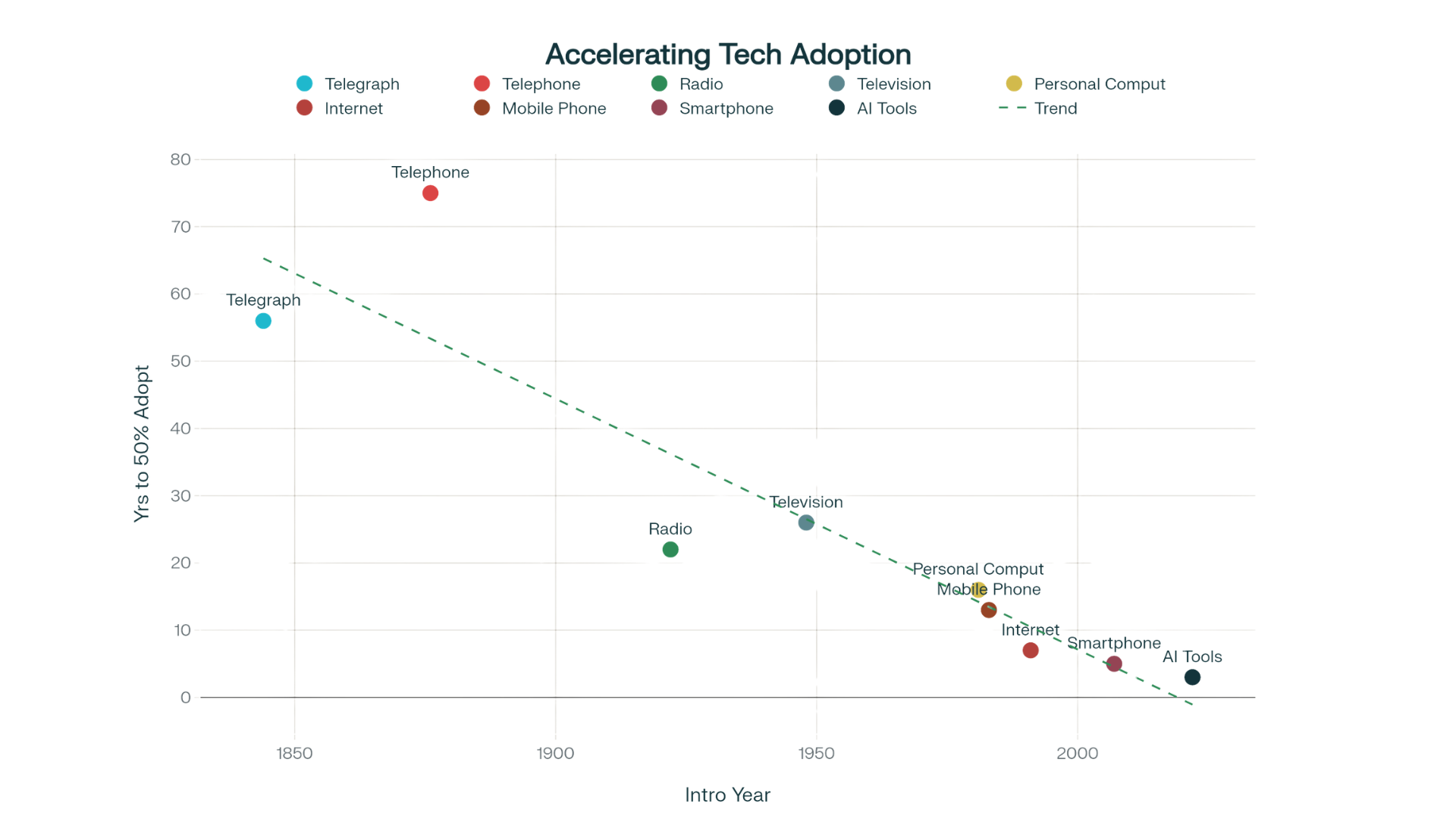
This chart shows how long it took for different technologies to be adopted by 50% of the populace.
For older technologies, like the telegraph and telephone, this was measured in decades, nearly centuries. Even the television took over 30 years before most people had one.
AI took three. That’s right; in just three years, AI was being used by 50% of the population.
Of course, with companies adding it to every tool we already rely on, it's bound to make its way into the public consciousness.
But is AI search a primary way businesses are being discovered? The answer is still a resounding no. While traffic from AI sources is growing, it's still such a tiny percentage that it's not worth spending time (or money) optimizing for unless you just want to have fun experimenting.
One important thing to remember is that, as of 2026, there is no way to track appearances (sometimes called ranks) in AI search.
When most operators say they're concerned about AI, they usually mean they want to make sure their facility is showing up when people search with AI.
If that's you, then here's everything you need to know about AI search!
.png?width=1920&height=1080&name=The%20Self%20Storage%20Owners%20Guide%20to%20AI%20-%20Part%201%20and%202%20(4).png)
Over 2025, Pug Pack operators went from less than 100 ChatGPT visits in January to almost 1,000 in December. This is massive growth, but it’s still tiny compared to the number of visitors using Google.
Of course, you want to show up anywhere storage is mentioned. You want to be the brand that people think of when they ARE ready to rent. But AI makes this really hard, because the results change with every user and every interaction.
But we can measure visits and rentals.
We’ve got some 2025 stats from across all our websites here, so you can see exactly how often AI is sending actual renters to a website:
Total online rentals: 111,989 – From AI: 89 – AI%: 0.079%
Total online reservations: 28,501 – From AI: 26 – AI%: 0.091%
Contact form submissions: 57,978 – From AI: 135 – AI%: 0.23%
First-month rental income: $5,163,495.05 – From AI: $5,769.30 – AI%: 0.11%
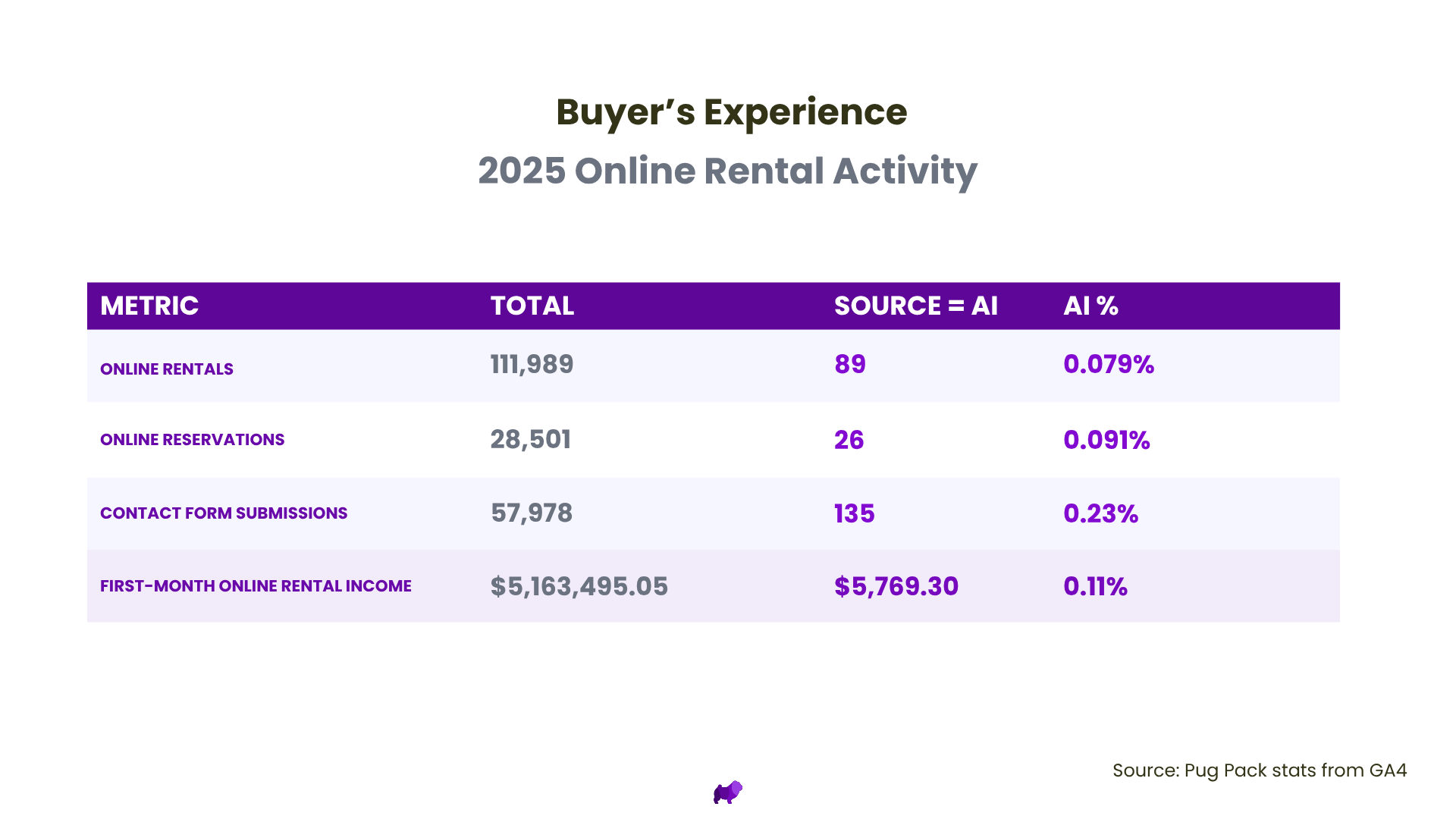
Less than a tenth of a percent of all rentals over 2025 came from AI sources. No data set is perfect (maybe someone discovered you on ChatGPT, then Googled your facility), but it’s a good sign that AI is not your primary traffic source. So far, it’s not even getting close.
The first thing to understand about AI search is that there's no real ranking system. There's also no way to track true appearances/rankings despite the promises some companies make at the moment.
Prominent experts from across the internet agree. If you're a data and research kind of person, you'll really enjoy this SparkToro article by Rand Fishkin, a well-respected search expert.
As he explains in the article, there's a manufactured randomness to the results you get from AI. You can ask the AI the same question hundreds of times and get different answers. Add in asking the same question from different accounts and it's even worse.
Rather than a ranking list like on Google, AI is like rolling dice. You may have multiple sides on the die, you may be the best answer, but that doesn't mean that it's going to land on your facility when it spits out the results. At least, not every (or even most of the) time.

The implication of this new search environment is massive. It means that every search result is unique. It means the concept of “ranking #1” doesn't exist in AI search.
Not only do AI results vary from searcher to searcher, but the types of results do too. Sometimes a searcher will see a list, sometimes a map. Sometimes the AI will offer lots of options, sometimes just one.
To complicate matters further, different models pull from different sources! Which means it’s more important than ever to have your business listed online (consistently) as many places as you can get it.
.png?width=1920&height=1080&name=The%20Self%20Storage%20Owners%20Guide%20to%20AI%20-%20Part%201%20and%202%20(3).png)
Summary: Make sure your website works well with AI, but remember, every single AI search result is unique. Don’t expect SEO-style rankings. AI platforms are continuing to experiment with their results, and searchers are continuing to evolve how they use them.
AI search uses a lot of the same signals that traditional search does, but it does not follow traditional search rankings. The best practices you use to rank #1 on Google are similar to those that will get you more mentions in AI, but there's one factor that is more important than before:
Brand mentions on other websites
AI will often reference the rest of the internet to judge and explain your business. While they may answer some questions using what's on your website (such as what your hours are, questions about your services, and so on), whether they recommend you as a good option is usually determined by what other people are saying about you.
This is reasonable, if you think about it. Rather than listening to a business say it's the best option, AI sees what others think is the best option and recommends accordingly.
If you're really concerned about showing up in AI, start getting mentioned in other places. This means aggregators such as RentCafe, but it also means local social media groups, best-of lists for your city, the chamber of commerce, and in pretty much any other places you can manage.
When it comes to the technical side of AI search, the more important part is that your site can be read by crawlers. Your website needs to be accessible and easy to navigate for the AI in addition to your renters.
A website that plays nice with AI has:
Simple is almost always better!
The best use for AI in self storage is improved operations efficiency.
Not necessarily in customer relations, which are still best managed by real, trained people. But crunching large numbers, for example, is a place where AI can shine in your operations.
Maximizing business efficiency is the biggest AI use case in storage – particularly for mid to large operators. In short, that means these companies are big enough and have complex enough systems that the process of outsourcing certain tasks or leveling up their capabilities is providing a significant business advantage.
Our industry is usually ten years behind the cutting edge. After all, Life Storage only offered the first online rentals in the industry in 2018! But operators are knee-deep in tech now. Whatever innovations start to surface in other industries will be adapted to storage quickly. We can’t afford to be a decade behind anymore!
Quick differentiation:
How do you determine which tech will help and which will only cost money? What is AI good at, and what is better left to the humans?

Larger operators may need paid models that they spend time training to do what they need. Small operators can use the free version of ChatGPT or Claude to:
If you’re looking to leverage the advanced capabilities of AI, there are plenty of ways to do that. We spoke to some industry experts and asked how they’re implementing this new tech.
Here are examples of how our friends in the industry are making AI work.
The first thing any mid-to-large business needs to do is build a unified data platform. You need to have one spot where “truth” lives in your company. Your branding, your data, your KPIs, and all other information need to live in one place that the AI can access. And it needs to be ensured that the AI won't train on that data.
Then all your internal tools need to be trained on that same source.
.png?width=1920&height=1080&name=The%20Self%20Storage%20Owners%20Guide%20to%20AI%20-%20Part%201%20and%202%20(8).png)
There are a ton of different use cases for current-gen AI models. Most of our experts overlapped in how they’re using the tools, so we’ve put all the purposes together and cited the experts who mentioned each one below.
Revenue Management
— Arty Fonov, Melissa Stiles, Craig Olinger, Simon Berman
Acquisitions
— Craig Olinger, Andrew Capranos, Simon Berman
Operations
— Arty Fonov, Simon Berman
Investor and Corporate Functions
— Andrew Capranos
There are pre-built tools for all of these. Most of the tasks in this category will not work well with an out-of-the-box ChatGPT subscription, though you could build a custom GPT or Claude project if you have the know-how.
.png?width=1920&height=1080&name=The%20Self%20Storage%20Owners%20Guide%20to%20AI%20-%20Part%201%20and%202%20(5).png)
What’s next for self storage and AI?
AI is growing rapidly. Even if you’re not blown away by what the technology offers now, the next innovation could be a game-changer.
And innovations are coming faster and faster! Anthropic is using its AI to program the next generation of AI – new features and new capabilities are likely to accelerate.
Here are some of the near-future changes that storage operators should pay attention to!
AI can do a lot of different things, some of which are useful to your business and some of which are not. It doesn’t help to have a dozen new companies promising revolutionary uses of AI – again, some are probably great, but it’s hard to sort good from bad.
If you’re looking to take advantage of this new technology, we’ve got you covered.
Great for dipping your toes into the pool. These are ways to use the free version of modern AI to improve your business, usually in just a few minutes!
To learn more about these quick wins, check out our Self Storage AI Prompts download!
Using AI for these tasks is going to take a lot more work, but the payoff will be much bigger. Most operators will need to partner with a new provider or get new software to implement these seamlessly (though some readers might be able to make these work alone!)
Using AI is not a goal in itself. Just like every other metric and tool in our arsenal, AI is only useful if it’s helping the business grow.
As exciting as this new technology is, and as helpful as it can be, the core business proposition hasn't changed. People need more room to store stuff, and we provide it. Technology can be a part of that, but it can’t be the main part.
The fundamentals will still determine the success or failure of your business. No amount of AI prowess will outweigh a bad experience.
Understand the customer journey - not only how people find you, but what they’re thinking when they go looking.
When you do start experimenting with AI, do it with intention. Measure your results, and don’t invest more in AI than AI can give you in return! AI search is still very small compared to Google and other avenues.
Lastly, pay attention. This space is changing fast, and your competition is going to be changing with it. Google is still the big game in town, but that might not be the case in three years (or less).
Check out these other pages to learn more about technology and self storage:
At StoragePug, we build self storage websites that make it easy for new customers to find you and easy for them to rent from you.