Self storage converts PPC clicks to paying customers at a higher rate than (nearly) any other industry – so why are we still paying $200-$300 to fill up a single unit?
Rental rates have decreased 24% over the last five years, but the cost-per-click of self storage Google Ads has gone up significantly. Maybe we’re doomed to spend more and more to get less and less back.
Or maybe we can run smarter ads.
In this guide, we’ll dive into the ways a savvy operator can gain an edge on the competition and get more value from their self storage Google Ads.
Storage operators can expect to spend 2-3x the value of a unit to get a renter.
Each click only costs a few dollars, though. That means you’re spending a lot of money on clicks that don’t convert!
Some of this is unavoidable. You won’t convert every click, no matter how amazing your facility is. But a lot of that money is spent on people who are unlikely to ever rent from you.
People rent storage for a wide variety of reasons. The 5 Ds, of course, or just to make more space at home (“too much stuff” has become the #1 reason people seek storage units). You can run ads targeting specific needs, and you should, but the surest way to find your renters is proximity.
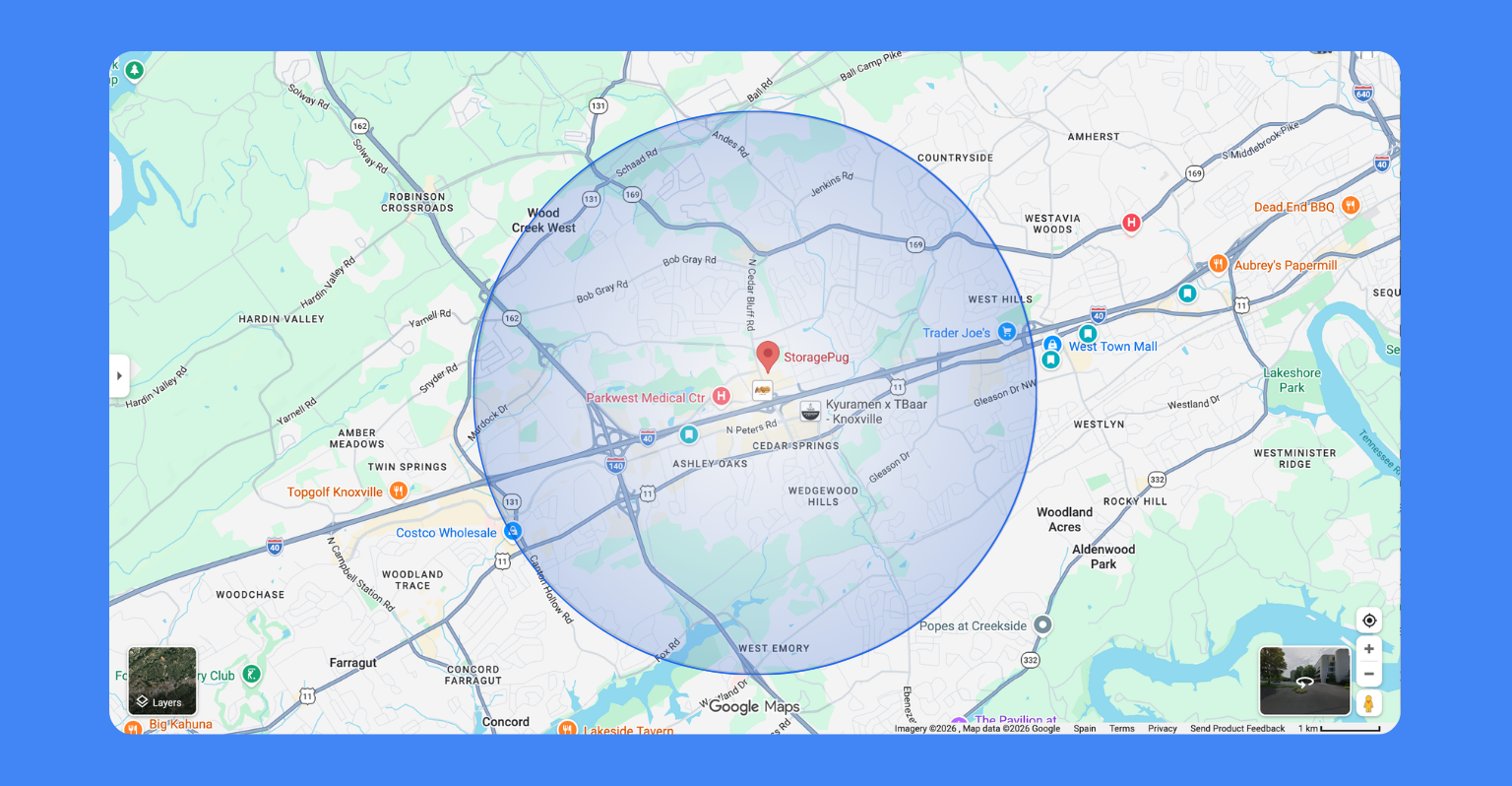
The majority of tenants come from within 3-5 miles of the storage facility.
You will see renters from further away, but this is usually because they have another interest in the area. They work nearby, their kids go to school nearby, or they drive past on the daily commute.
Self storage operators should set a geotargeting boundary of 5 miles or fewer around their facility. If you’re in a rural area with low competition, you can set the boundary to 7 miles, but no further than that.
Some renters will have an address that is much further away! Some operators have big clusters of tenants in nearby towns outside of their advertising range, so they want to run ads in that city – which might work! It’s certainly worth a try, but you need to keep close track of your ROI.

Software can track billing addresses and give you a map, but it can’t tell you where they were searching from. Your click might have been searching from just down the road at their office building. It’s much more cost-effective to serve ads to people you KNOW are close by, rather than hoping to snag people the next town over.
That being said, if you have the time and money, experiment with running ads in nearby population centers. Be sure you can afford the experiment; don’t use your whole marketing budget on a hunch.
Google Ads will let you upload a CSV (spreadsheet file) of your existing customers, and then exclude that list from your ad targeting. This won't be perfect, because Google can't always match the info you give with the IP address performing a search, but it helps.
First, you'll need to export a spreadsheet of your customers. Your facility management software should have a way to do this.
Once the list is populated, exclude it from your campaigns:
This tactic won't save you a ton of money, but it's a good best practice!
Start with exact match keywords instead of broad match. Exact match means that Google will only show your ad for the exact searches you’ve given, whereas broad match could end up showing up for searches like “storage containers near me” – which is someone looking for plastic totes, not storage.
When choosing self storage keywords, we’ve got very limited information. Keyword trackers won’t find data for most city-specific terms unless you’re in a major metropolis because there’s not enough volume. So instead, we need to look at national trends and apply those to our area.
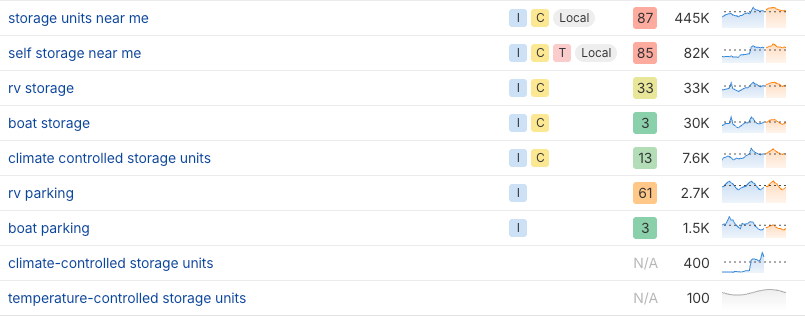
*Stats pulled from AHRefs 3/2/2026, monthly, US searches only
Don’t start off targeting every keyword listed here! If you’re testing the waters with keywords for the first time, check out the options below:
Then throw in “storage units [city, ST]” and “self storage [city, ST]” and see how your campaign does for a month.
These are both high-volume and high-intent (meaning that people who search these phrases want to rent storage). The cost-per-click will be high because these are also the most obvious keywords. If you can convert them at a good rate, though, CPC ads are an incredibly cost-effective way of getting renters.
If you’re in a competitive neighborhood, you might need to start refining down to more specific keywords so you’re not competing with the REITs for every search.
IMPORTANT NOTE: Each individual ad should match the keyword it targets. If you target “storage units near me,” that ad copy (wording) should focus on storage units, not RV storage, document storage, or wine storage.
Independent storage facilities operators should begin with Google’s “Smart Bidding” functionality. You’re asking Google to spend your money wisely, and it usually does a pretty good job of it. The algorithm will sometimes overspend on a click you can’t convert, but all-in-all, it does a good job.
With Smart Bidding, you set a limit for how much you want to spend per day, and Google tries to spend that ad budget to get you the most rentals possible.
As before, make sure you keep it to exact match keywords – this reduces the number of useless clicks you’ll get.
Set your campaign to maximize conversions. This tells Google that you care more about calls, visits, contact form fills, reservations, and rentals than you do about clicks.
Do NOT use Google’s Performance Max campaigns. These will show your ads in all sorts of places that don’t have renters, like YouTube ads or unrelated Facebook groups. Performance Max campaigns are great for industries that sell to wider audiences, but in self storage, we only want to target people who are already shopping for storage.
Most small operators won’t have time to manage their bidding strategy effectively. Large companies hire full-time ad campaign managers to keep everything optimized – but small operators don’t have the money to hire or time to do it themselves.
Google won’t get it right every time, but it will save you time and money. In most cases, it makes more sense to let the algorithm handle it.
If you DO want to manually bid on ads, you can set price points for each keyword within each ad group. Google still uses Just-in-Time bidding, so you won’t always spend the exact amount you bid for each keyword. This can add some optimization to your campaign, but only if you’ve got someone putting a lot of time and effort into it.
On the campaign level (which, for storage, is usually the individual facility locations), you can add Extensions to help your ads convert. When you go into Extensions for your campaigns, Google will tell you what information you need for each one. Fill out every extension you can, as it gives Smart Bidding more tools to work with. Don’t sweat it too much if you can’t fill every one, though. Prioritize:

Now you’re all set up to get your ads in front of potential customers – but what should those ads be? How do you get from showing ads to getting renters?
Don’t overthink the copy (wording) on your ad. There’s a time and place for being clever in your advertising, but with a short character limit and a target keyphrase, direct is best.
You know your facility and your target audience best, so trust your instincts. But err on the side of simple, clear copy. We’re pitching a facility to someone who has already typed in what they want – the best ads tell them, “Hey, here’s that thing you want!”
Remember, give searchers a reason to choose you.
Then, once you get the click, make sure you have continuity between that ad and the landing page the ad sends them to.
12-Month Rate Lock | Storage Units in Knoxville, TN | 4K Security Cameras
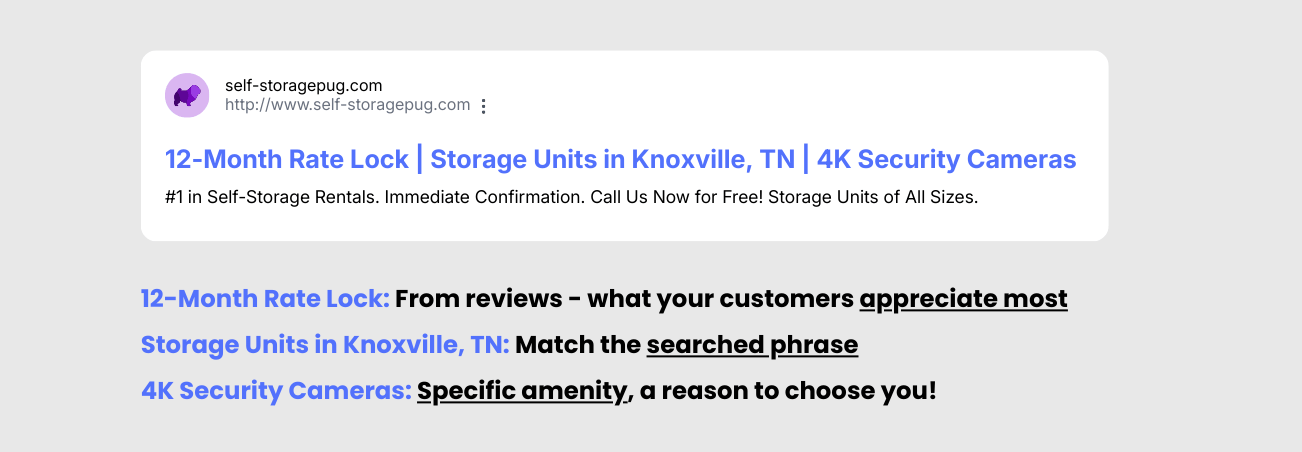
This part is tricky! A lot of people just link to their regular units page or home page, and hope that it converts. After all, your website is built to convert renters, right?
The big key here is to maintain continuity from the ad to the page. Whatever value-prop you used in the ad convinced someone to click, so you should continue to hammer that home.
Most shoppers who click your ad are looking to rent. You want to make sure nothing disrupts their journey.
The basic structure of a Google Ads campaign runs through several levels. Each level has different functionality and different purposes, but here’s what works best for self storage:
Why organize them this way?
The simplest and best way to determine whether your Google ads are succeeding is to calculate the return on investment. See how much it costs per rental, then calculate how much money you’re bringing in per rental.
Operators will sometimes look at the monthly price of their unit and value a customer based on that. However, most renters stay for more than a month! Most stay for longer than they intended at the beginning.
Look at your customer base and see how long the average customer stays. Then take that number (in months), and multiply it by the monthly rental rate of the unit the new searcher has rented. That’s your Customer Lifetime Value.
For example, if your customers stay an average of 12 months, and your Google ad just brought in a new customer to your $100 10x10, the value of that click was $1,200.
Take the total amount of money you spent on ads in a month, then see how many rentals those ads brought you. Calculate the CLV of all those renters, then compare that to how much you spent.
There is no clear benchmark for what a “good” campaign looks like, but we can start by looking at how much you might pay for Sparefoot or other expensive lead generators.
Typically, you could expect to pay 2-4x a unit’s monthly rent to acquire a lead from aggregators. If you’re spending less than that in ads, you’re at least doing ok. If you’re spending significantly less than that on ads, great!
Take your business further with these deep dives:
At StoragePug, we build self storage websites that make it easy for new customers to find you and easy for them to rent from you.
With Insights, our self storage marketing platform, operators get the data and digital tools they need to make the get out of their website and their self storage investment.