When was the last time you updated your rates?
It’s easy to fall into the trap of setting your rates and barely moving them over the course of the year.
For many operators, rate management might be something that’s done only in reaction to some outside force. Rentals have slowed—drop the rates! The facility up the road has way higher prices—let’s raise ours!
Sound familiar?
If so, we get it. Rates are intrinsically tied to how many rentals you get, and that makes it difficult to make big changes.
But updating your street rates frequently is important if you want to get the most out of your storage facility.
While raising rates can be scary for some storage owners, there are a few signs that the time is right for it.
In our Gabfocus episode on Optimizing Occupancy, our guest—Andrew Sherrard of Reliable Storage—talked about the importance of managing your rates:

Andrew Sherrard
Reliable Storage
Based on what Andrew says, here’s what you should be tracking to confidently raise rates:
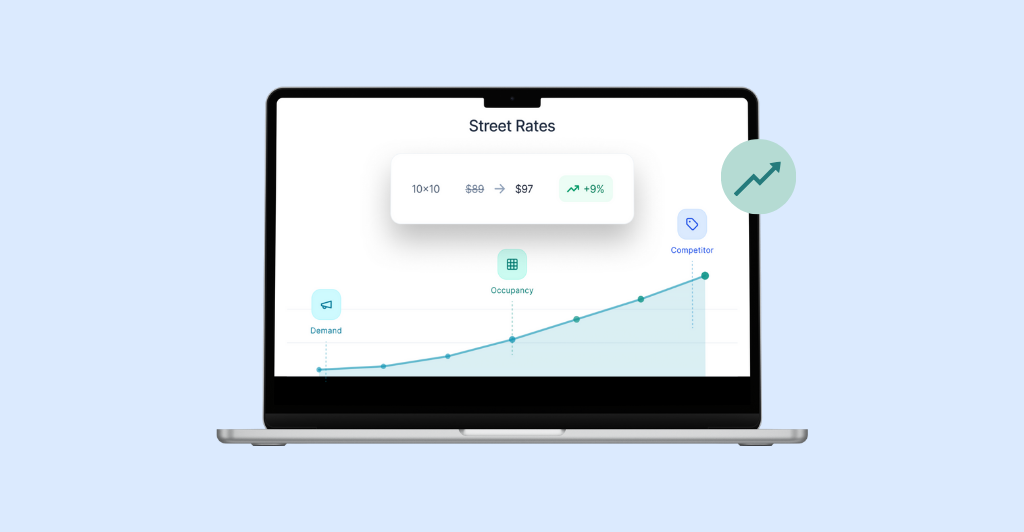
The sign: You’ve seen an unusual uptick in rentals for a specific unit type or size.
Why it matters: A high volume of move-ins on a certain unit type means that demand is up. It could also indicate your rates are much lower than competitors.
Knowing the trend of recent move-ins helps you determine if a certain unit type is very popular at the moment.
A unit that is seeing an abnormal number of move-ins is in more demand, and so you can raise rates on it to capitalize. This demand might be because of new neighborhoods being built, special events popping up in town, or simply because your competitors have run out of those unit types, and people are having to travel further to find the size they need.
Whatever the reason, this is a sign to increase your rates!
The sign: Your reports show that a specific type or size of unit is nearly full.
Why it matters: This also means this unit type has high demand, and you can afford to raise rates. This also allows you to create a perceived discount for the next unit up.
This is very similar to sign #1, but it’s worth calling out on its own.
While sign #1 is about a flurry of move-in activity (regardless of overall unit type occupancy), this second sign is all about the actual occupancy of a unit type.
If you notice a unit type is nearly full, then it may indicate high demand even if there haven't been a ton of rentals recently. You can then create a perceived discount for the next unit size up by increasing the rates on the nearly full unit and keeping the larger (and less occupied) unit at the same rate.
Market these bigger units in context. Ie, "Upgrade to a 10x20 for only $20/month more!"
The sign: When shopping competitors, you notice their rates have gone up
Why it matters: A shift in competitor pricing could mean that demand in the market is going up. However, make sure to still consider your own occupancy and move-ins when assessing.
A competitor raising their rates is a good sign that business is starting to pick up.
If their rates are going up, it means you may safely be able to raise yours, as well—especially if multiple competitors start to go up.
Ultimately, your own occupancy and move-ins should always be the top indicators. But a competitor’s rates are a good way to keep a pulse on the market and decide if you need to take a closer look at your own numbers.
Just don’t make a choice based purely on their movement.
Dropping rates can also be intimidating. Operators often fret about how much potential money they might be losing by reducing street rates.
But as Andrew puts it, “Sometimes you might be a little reluctant, because you’re like ‘Oh man, I’m going to lose too much revenue.’ But I’d much rather have occupancy than potential revenue.”
Get people into those vacant units, because a month without a rental is way worse than a month with a cheaper rental.
So, what are the signs? They’re already things you should be tracking!
These are all essentially the opposite trends of the signs for raising rates, with the exception of customer feedback.
Customer feedback on rates doesn’t necessarily mean people complaining about rate increases. It means that if you find yourself losing sales over the phone or in person, and price seems to be a frequent reason why, then you should look at lowering the relevant rates!
If you set your rates and forget them, you're leaving money on the table.
Sometimes that money is in the form of lost rentals due to high prices. Sometimes it's in the form of filling your facility with units renting for under the market rate.
The only way to truly optimize your occupancy—including your economic occupancy—is to pay active attention to your rates and to your market and keep adjusting your rates as necessary.
Here are some of my other favorite posts to check out!
At StoragePug, we build self storage websites that make it easy for new customers to find you and easy for them to rent from you.